
Georgetown County Criminal Court Cases
The Court of General Sessions is the criminal side of Circuit Court. It handles felony and other higher-level prosecutions for Georgetown County as part of the Fifteenth Judicial Circuit with Horry County. The Clerk of Court keeps the General Sessions file. The Solicitor prosecutes the charge but is not the neutral custodian for certified docket copies.
Lower-level records are divided among Magistrate Courts and municipal courts. Georgetown County has Central Traffic, Central Jury, Central CDV, Andrews, Murrells Inlet, Northwest Regional, and Pawleys Island summary dockets. City courts hear ordinances and qualifying criminal or traffic matters within their authority. A General Sessions search cannot be treated as a search of all those courts.
Which Georgetown Court Holds the Case
The charge level, issuing authority, and caption point to the right counter. The county's court directory and the case detail can prevent a trip to the wrong office.
| Court | Role | Contact |
|---|---|---|
| General Sessions | Felony and higher-level Circuit Court cases | 401 Cleland St.; 843-545-3054 |
| Central Traffic | County traffic docket | 843-545-3371 |
| Central Jury | Summary jury matters | 843-545-3383 |
| Central CDV | Designated summary domestic-violence docket | 843-545-3381 |
| Andrews Summary | Statutory Magistrate matters | 843-545-3631 |
| Pawleys Island Summary | Statutory Magistrate matters | 843-545-3633 |
Murrells Inlet Summary Court uses 843-545-3635, and Northwest Regional Summary Court uses 843-545-3637. For a municipal case, contact the city named on the ticket or summons.
Andrews illustrates why the court name matters. Andrews Municipal Court and Andrews Summary Court share 110 North Morgan Avenue, yet they are distinct courts with different authority. A street address alone therefore does not identify the custodian. The ticket, warrant, case caption, and issuing agency should be checked before asking for a Georgetown County disposition.
Searching Georgetown County Case Records
The Georgetown Public Index is the free online starting point. A party search works when no case number is known. Date and court filters help with common names. The official statewide Case Records Search gateway confirms access to Circuit and Magistrate systems and notes that only some Municipal Court files are available.
The official Georgetown Public Index interface shows the county-specific route used for online criminal case searches.
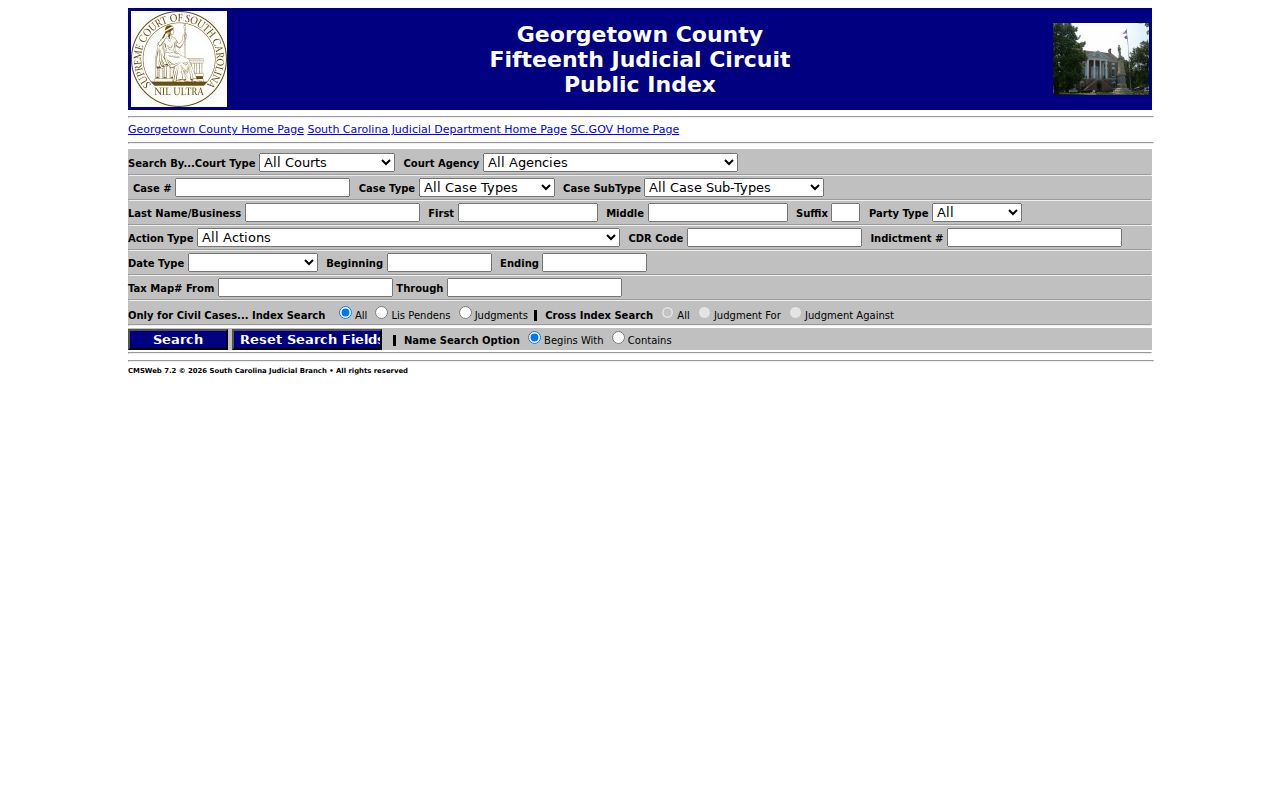
The docket should be treated as an index. Verify identity and open the case detail before relying on a result.
| Control | Type | Use |
|---|---|---|
| Last or business name | Text | Required for the party route |
| First and middle name | Text | Narrows likely matches |
| Case number | Text | Direct route when known |
| Court agency or case type | Dropdown | Limits the Georgetown County docket |
| Beginning and ending dates | Date | Narrows filing period |
Georgetown Public Index Has Limits
A listed event does not mean its document image is available online. Fresh entries can lag, old papers may not be digitized, and a sealed Georgetown County criminal case will not appear like an ordinary public file. Home addresses were removed from old and new South Carolina case records beginning January 1, 2026.
If a known case is absent, search spelling variants and a wider date span. Then give the clerk the name, approximate filing date, court, and any case number. Ask whether the matter belongs to a Magistrate or Municipal Court before requesting a General Sessions search.
Note: An empty online result is not proof that no Georgetown County court record exists.
Inside a Georgetown County Case File
A Georgetown County docket header can show the county, case number, court agency, filing date, case type, and status. Party and attorney entries identify who is in the case. Charge rows may supply descriptions, codes, level, and key dates. Events can include warrants, filings, hearings, pleas, disposition, and sentence, though detail differs by court and case.
| Case header | County, number, court agency, filing date, type, and status |
|---|---|
| Parties | Defendant, prosecuting party, and attorneys when supplied |
| Charges | Description, code, level, and separate outcome dates |
| Events | Filings, hearings, warrants, pleas, rulings, and sentence entries |
| Financial entries | Assessments and payments when exposed, not a certified balance |
| Documents | Filing labels even when no public image is available |
Mixed outcomes must be read count by count. A dismissal on one charge does not decide another count in the same case.
Georgetown Copies and Certified Records
The General Sessions clerk FAQ states that public counter research is available from 8:30 a.m. to 4:45 p.m. at the Georgetown County Judicial Center, 401 Cleland Street. Ordinary copies cost $0.25 per page. Certification costs $1. The clerk does not run criminal background checks, but a visitor may inspect the public file or send another person to research it.
The official FAQ capture documents Georgetown County's local copy rules and the route for court-date questions.
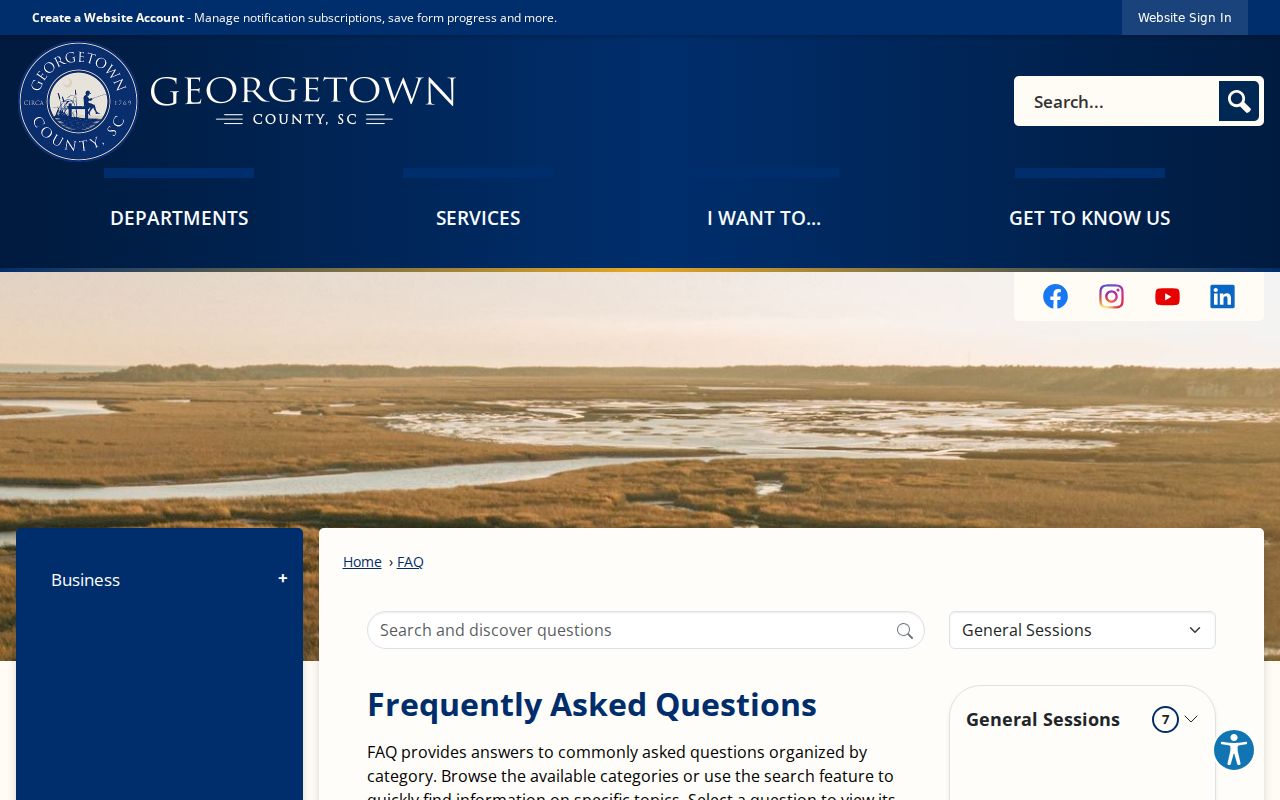
General Sessions court-date calls go to the Fifteenth Circuit Solicitor at 843-545-3169. The Clerk's main case-inspection number is 843-545-3047.
Allow time for courthouse security and carry identification when asking for material that may require proof of identity. Published jury-session hours are not records-counter hours. The clerk's stated research cutoff remains 4:45 p.m. Accessibility or language help should be arranged through the court handling the proceeding, since the local material does not promise same-day interpreter service.
Clerk of Court
Georgetown County Judicial Center
401 Cleland St.
Georgetown, SC 29440
843-545-3047
Fifteenth Circuit Solicitor
Georgetown office
401 Cleland St.
Georgetown, SC 29440
843-545-3169
How a Criminal Case Moves
A jail charge is preliminary. After an investigation and arrest, a bond or initial appearance addresses custody and basic notice. The prosecutor reviews the evidence and may seek an indictment or use another authorized charging route. The filed charge can differ from the booking label.
Case flow: Charges Filed › Arraignment › Pretrial › Plea or Trial › Disposition › Sentencing
Motions, discovery, amendments, and hearing entries build the Georgetown County case docket as it moves. A plea or trial produces a result, and a conviction leads to sentence. An appeal can add another layer after judgment.
Read Georgetown Outcomes Charge by Charge
Pending means no final outcome has been recorded. Nolle prosequi means the prosecutor chose not to continue that charge at that time. Dismissed does not mean convicted, and an arrest entry is not a disposition. An acquittal follows a not-guilty adjudication, while a conviction follows a guilty plea or verdict.
- True bill
- The grand jury returned the indictment for prosecution.
- No bill
- The grand jury did not return the proposed indictment.
- Arraignment
- The charge is formally presented and a plea is entered.
- Disposition
- The recorded result for a charge or case.
- Sentence
- The court-ordered consequence after conviction.
A SLED report and Georgetown County court file may use different levels of detail. When a statewide history lacks the result, a certified court disposition can support an accuracy challenge.
Georgetown's 2011 Docket Backlog Order
A South Carolina Supreme Court order dated March 18, 2011 recorded 8,137 pending criminal and traffic cases in Georgetown Magistrate and Municipal Courts, including 404 older DUI or DUAC matters. The Court ordered faster trials. It is a historic milestone, not evidence of today's pending count.
The episode shows why the event dates and status lines in a Georgetown County docket deserve close attention. A filing date does not reveal whether a charge moved at an ordinary pace, was delayed, or later reached a result. For an old matter, collect the case number and every displayed status date, then ask the named court whether later entries or paper documents exist outside the online view.
Older summary-court cases may also use labels unfamiliar to a current reader. Ask the clerk to identify the operative disposition instead of treating the last visible event as the final result.
Case Record Access and Restrictions
South Carolina court records are generally open unless law or a court order restricts them. Juvenile matters, sealed cases, protected victim information, identifiers, and certain investigative details are not ordinary public content. Online redaction may also be broader than the paper file available to an authorized person.
The South Carolina Freedom of Information Act supports access to public agency records, but it does not override a sealing or expungement order. Ask for segregable public portions when one part of a record is exempt. For qualifying dismissed, acquitted, or nolle-prossed matters, S.C. Code § 17-1-40 governs removal through the stated process.
Access point: A missing online Georgetown County criminal case may require a clerk counter search, but sealed files remain unavailable through ordinary public channels.
Georgetown Court File or SLED History
A court file answers what Georgetown County prosecutors filed, what happened at hearings, and how each charge ended. A SLED CATCH report is a statewide identity-based compilation. It depends on fingerprints and on agencies reporting dispositions. Neither is a copy of the other.
| Question | Best source |
|---|---|
| What charge was filed and disposed? | Exact Georgetown County court file |
| What South Carolina cycles are tied to the name? | SLED CATCH |
| What did the officer report? | Arresting agency incident file |
| Was the person booked or released? | Georgetown County booking channel |
When the question begins with custody instead of the filed case, the county's arrest lookup routes explain the sheriff, detention, agency-report, and court sequence.
For self-review, compare the arrest date, arresting agency, charge wording, and outcome date across both sources. If Georgetown County shows a dismissal that the state history lacks, obtain the certified disposition first. Send the correction to the office that supplied the inaccurate event and follow SLED's challenge route. That is more precise than asking the clerk for a general background check it does not provide.